2023/24
Hay

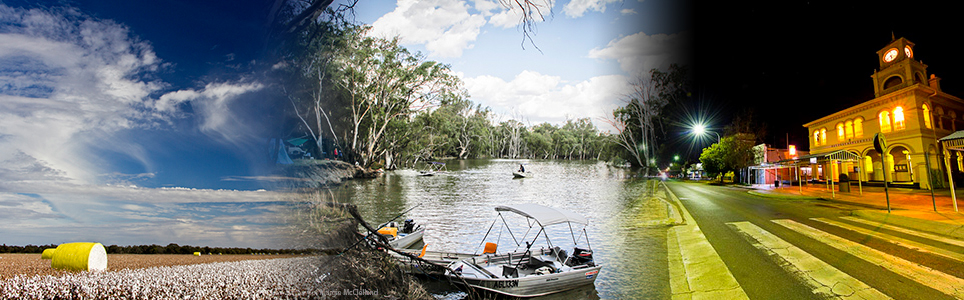
Hay Shire is located on the banks of the Murrumbidgee River on largely flat terrain including saltbush plains with river red gum and black box corridors along river. The Shire is one of Australia’s leading wool and sheep meat producing areas. A wide variety of fruit and vegetables are grown, picked and packaged in Hay with lettuce, pumpkins, tomatoes, garlic, corn, rockmelons, watermelons and broccoli among them. Irrigated crops grown around the Hay area are maize, cotton, wheat, oats, barley, cereal rye, grain sorghum, sunflowers, soya beans, rapeseed, large seeds and legumes. Pasture crops include paspalum/white clover and sub clover/rye grasses are the normal winter pastures.

Data for this website has been sourced from Council’s financial statements, Council’s annual report and Council’s data returns. The website also refers to data from a number of agencies and entities. Please refer to the data page of this website for links to definitions, information on performance measures, benchmarks, OLG Groups and the data sources that have been used.

Please contact Council if you would like any further details or explanations regarding individual results and any differences between your Council’s performance and that of another council.

Contacting Council

Address:
134 Lachlan Street
Hay NSW 2711
Postal Address:
PO Box 141, Hay NSW 2711
Phone: 02 6993 1003
Fax: 02 6993 1288

Your Local Government Area

Result
Population (No.) 2,861
Area (Km2) 11325.9
Council Classification Rural
OLG Group 9
State Planning Region Riverina Murray
JO Region Riverina and Murray

Your Council

Result Group Avg. *
Councillors (No.) 8 9
Population per Councillor (No.) 358 330
Equivalent Full Time Staff (EFT) (No.) 58 91
2023/24 Revenue ($'000) 25936 36382
2023/24 Expenses ($'000) 17474 27590
Residential Pensioner Rebates (%) 19.00763359 19.97692652
Population Density (residents per Km2) 0 0.535714286
* A NSW council group is determined firstly by whether they are Urban or Rural in nature, and then by population size and density. Please refer to OLG Groups in data tab on website for more information on how individual councils are classified. An OLG group average is then calculated by the average of the same group number eg. All Group 5 Regional Towns/City or all Group 8 Rural.

Your Public Facilities

Result Group Avg.
Public Swimming Pool Complexes (inc rock pools) (No.) 1 2
Public Halls (No.) 6 5
Public Libraries (No.) 1 0.857142857
Open Public Space (ha) 128.78 63.64357143
Total Road Length (km) 941.36 1,611.80

Demographics of Population

under 20 years
20 - 59 years
60 years and older

Council population (%)

Group population (%)

4.0%

population change last 5 years

Source: ABS, Estimated Resident Population (ERP)

Your Local Population

Latest Outcome Group Avg.
Five Year Population Change (%) -4.035266192 -2.885600707
Population aged under 20 years (%) 25.3 25.2862021
Population aged between 20 and 59 years (%) 44.6 44.61753445
Population aged 60 years and older (%) 30.1 30.09626345
Aboriginal & Torres Strait Islanders (%) 10.7 18.70432
Speaks language other than English at home (%) 4.1 3.535714286
Socio-Economic Index Rank (1 low, 128 high) 30 46.07142857

Council Population Gender

Aboriginal & Torres
Strait Islander

Language Diversity

Rest of population

Your local population (%)


Your Local Economy

Result Group Avg.
Unemployment Rate (%) 3.2 2.55
Avg Taxable Income ($) 48381 45004.92857
Avg Household Size (No.) 2.3 2.407142857
Value of DA's determined ($'000) 7743 13130
Active Businesses in LGA (No.) 405 460.5714286

Largest Industry Employer

Agricutlure, Forestry & Fishing